Lost time
The Minds of Billy MilliganLost time names the disorienting interval in which a person becomes aware that time has passed without being able to remember what occurred within it. In the account of Billy Milligan, this is not merely a lapse in recollection: it is a break between one place or action and the next, with consequences for his sense of responsibility, his fear of harming others, and the narration’s ability to establish a reliable chronology.
Meaning and Experience
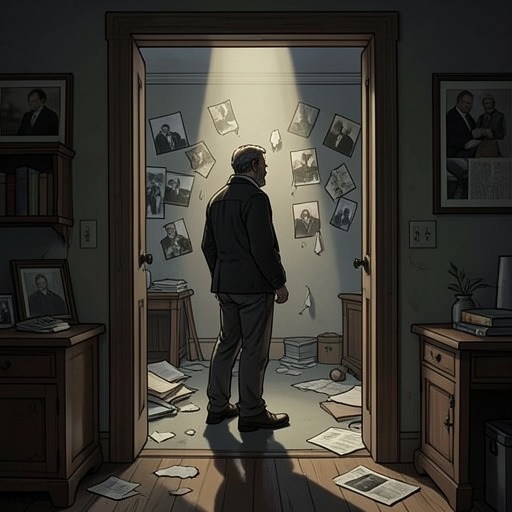
Allen describes lost time as something that happens to all of them. A person can be somewhere doing something, then suddenly be somewhere else, able to tell that time has passed but unable to say what happened in the interval. The key feature is not simply forgetting a detail. It is the discontinuity between an earlier situation and a later one, with no remembered sequence connecting them. Allen adds that the experience never becomes familiar or easy to bear.
The phrase also appears in the account of Billy Milligan’s experience outside that explanation. When asked about his problems, Billy says that he does things and does not remember them; he goes to sleep, and other people later tell him that he did things. He identifies the reported actions as bad and criminal. His account makes the gap socially consequential: other people’s reports supply events that he cannot retrieve from memory, leaving him to confront alleged actions without an accompanying recollection of having performed them.
Fear, Sleep, and Restricted Awareness
Lost time is tied to Billy’s fear of what may have happened while he was absent from awareness. When asked what he thinks after being told that he has done something bad, he says that he wants to die because he does not want to hurt anybody. His trembling is so severe that Dr. George Harding changes the subject. The passage connects the memory gaps not to indifference about the consequences, but to acute distress about possible harm that Billy cannot remember causing.
Another account explains that Billy is kept asleep because allowing him onto the spot would lead him to kill himself. Allen says Billy is still afraid of being hurt and does not know about the rest of them; all he knows is that he loses time. The distinction matters: Billy’s experience of the gaps does not give him a clear understanding of their source. He experiences the discontinuity, but lacks the information that Allen’s account supplies about other personalities and the spot. When Billy says that, while asleep, he hears someone trying to talk to him but cannot understand what is being said, the narrative presents awareness as partial rather than simply absent: something reaches him, yet it does not become intelligible knowledge.
Ragen and the Missing Interval
The term becomes especially consequential in the account of three episodes associated with Ragen. Within a two-week period, Ragen drinks and takes amphetamines, then jogs eleven miles across town in the early hours of the morning to the Ohio State University campus. After selecting a victim, he leaves the spot. The next thing he remembers is finding himself in downtown Columbus with money in his pocket; he concludes that he committed the robberies he had set out to commit, although he does not remember doing any of the three. The interval between intention and the later discovery is the missing time: a conclusion about what happened takes the place of remembered action.
The conversation also marks the limits of what can be confidently assigned to Ragen. Evidence that someone threw bottles into a pond and took target practice is discussed alongside the robberies. Judy Stevenson corrects the description of Ragen as blacking out: he leaves the spot. Gary Schweickart points to the woman’s account of the gun, which Ragen struggled to operate before missing bottles at which he fired. Gary argues that this is inconsistent with Ragen’s expertise. Arthur’s rule that the others are forbidden to handle Ragen’s guns adds another restriction, but does not itself identify who handled the weapon. The episode therefore makes lost time part of an unresolved problem of knowledge and attribution: the gaps interrupt Ragen’s account, while the surrounding evidence complicates any simple explanation of the events.
Chronology and the Book’s Method
Lost time is also a problem for the book’s reconstruction of Milligan’s life. The author explains that Milligan had frequently lost time since early childhood, rarely attended to clocks or calendars, and was often embarrassed to admit that he did not know the day or month. A life recorded from memory alone could therefore not supply a dependable chronology. The narrative’s ordered account depends on external traces as well as recollection.
To place events in time, the author uses bills, receipts, insurance reports, school records, employment records, and other documents provided by Milligan’s mother, sister, employers, attorneys, and physicians. Milligan rarely dated his letters, but a former girlfriend had kept hundreds of letters he wrote during his two years in prison; postmarks on their envelopes helped establish their dates. The contrast is central to the expression’s significance: where personal memory leaves an interval blank, documents preserve dates and circumstances from outside that memory. Lost time is thus both an experience described within the story and a formal obstacle that shapes how the story can be told. The book’s chronology does not erase the gaps; it assembles a sequence around them.